
Family & kids
Children's Eye Exams: Protecting Your Little One's Sight
Sight is crucial for a child's development and learning. A vision problem can go unnoticed and hold back their success at school. This guide explains the importance of regular eye exams and when to see an optician to protect your child's eye health.
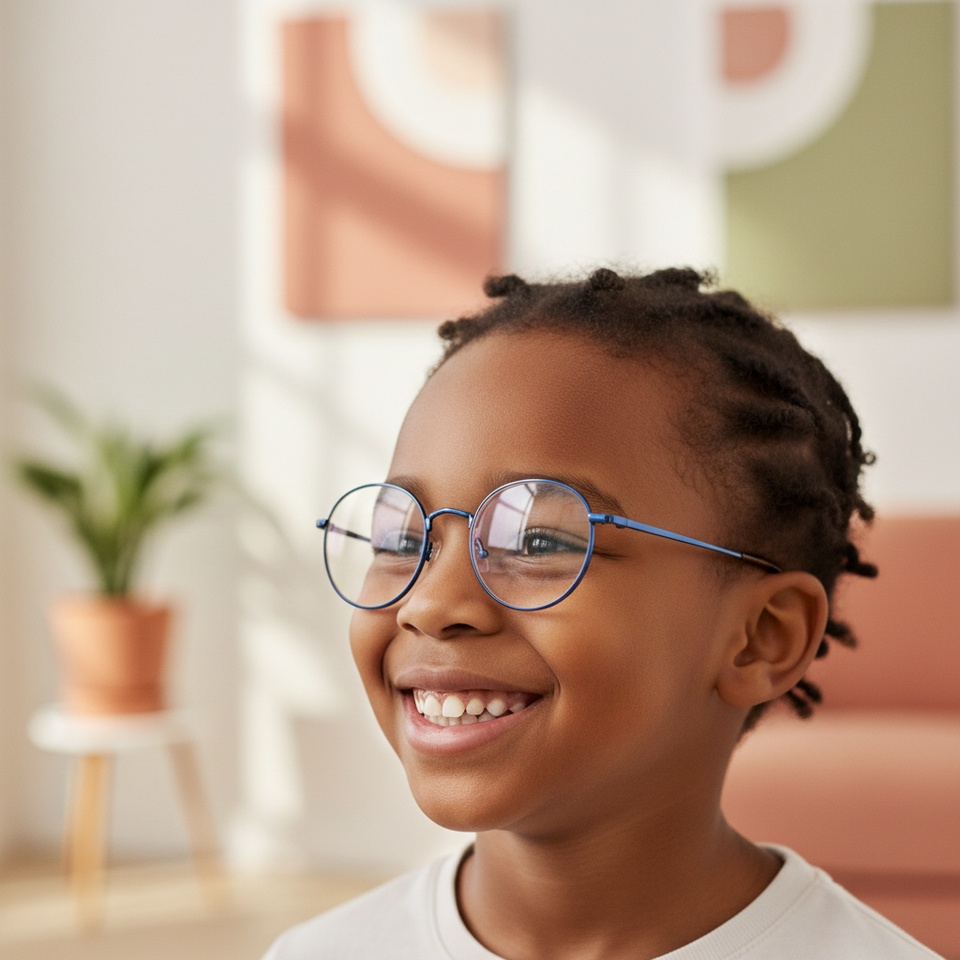
Your child's sight is their first window to the world. It’s how they discover faces, learn to read, play, and interact with their surroundings. However, a vision problem, even a minor one, can go unnoticed and slow down their development and success in school. Many parents worry but don't know when or how to act. This article is a simple guide to help you understand the critical importance of eye exams for children and how to protect their eye health for the future.
Sight, a cornerstone of child development
It is estimated that nearly 80% of a child's learning happens through sight. Good vision is therefore essential for:
- Learning to read and write: Distinguishing letters, following a line in a book, copying what is written on the board.
- Motor skills development: Catching a ball, avoiding an obstacle, riding a bicycle. Poor distance perception can make a child clumsy and insecure.
- Social interaction: Recognising facial expressions, making eye contact, feeling comfortable in a group.
- Concentration: A child who has to constantly strain to see clearly gets tired faster, may suffer from headaches, and can become restless in class.
The biggest challenge is that a child often won't complain. They don't know they have poor vision because it's the only way they have ever seen. To them, blurry or double vision is normal. That's why the responsibility for screening falls on parents and professionals. Acting early gives them the best chance to succeed.
When should you get your child's eyesight checked?
Preventing vision problems starts long before a child can read. A regular check-up schedule is the best strategy to ensure good eye health throughout their growth.
Visual screening from a very young age (0-3 years)
The first checks are crucial for detecting serious but rare conditions that must be treated very early.
- At birth: A first examination is often done at the maternity ward to check for abnormalities (like congenital cataracts) and to ensure the eyes react to light.
- Between 6 and 9 months: Your paediatrician or a specialist can perform a baby vision screening to check for proper eye alignment (to rule out strabismus) and the ability to follow an object.
- Around 2-3 years: A first real check-up with a professional is recommended. At this age, visual acuity can already be assessed with tests adapted for toddlers (pictures, drawings).
The key age for starting school (3-6 years)
Starting nursery school is a fundamental step. The child begins pre-reading, drawing, and writing activities, which heavily rely on their near vision. A comprehensive eye exam before or during the first year of school is essential to ensure a vision problem does not disrupt their early learning. It's often at this age that conditions like farsightedness or astigmatism are detected.
Regular follow-ups during schooling (after 6 years)
A child's vision changes as they grow. An eye exam is recommended at least every two years, and annually if there's a known issue or complaint. The onset of myopia (nearsightedness) is common from this age, especially with increased screen time. Regular monitoring allows for updating prescriptions if necessary and preventing a drop in school performance due to uncorrected vision.
What are the warning signs to look out for?
Even if your child doesn't complain, certain behaviours can be a sign of a vision problem. Be on the lookout for these clues:
- They often squint to see in the distance or struggle to focus.
- They rub their eyes frequently, complain of headaches (especially at the end of the day), or have itchy eyes.
- They tilt or turn their head to watch television or read.
- They close one eye to see better.
- They get very close to their book, paper, or screen.
- They have difficulty reading: they skip words or use their finger to follow the lines.
- They are sensitive to light (photophobia).
- One of their eyes seems to "wander" or is not perfectly aligned with the other (strabismus), even occasionally.
- They are surprisingly clumsy, frequently bumping into things or having trouble catching objects.
If you notice one or more of these signs, do not hesitate to book an appointment for a comprehensive eye exam.
What happens during a child's eye exam: Don't worry!
The idea of an eye test can sometimes worry parents and children. Rest assured, children's eye exams are designed to be simple, quick, and fun. The optician or ophthalmologist is trained to make your child feel comfortable.
An exam typically follows these steps:
- The conversation: The professional will ask you questions about family history, the child's development, and any signs you may have noticed.
- Visual acuity tests: For younger children who cannot read, we use tests with pictures, drawings, or "tumbling E's" pointing in different directions. For older children, the famous chart with letters of different sizes is used.
- The objective exam: Using instruments that do not require the child's active participation, the professional can objectively measure for a vision problem (myopia, hyperopia, astigmatism).
- Binocular vision assessment: We check that both eyes are working well together.
At Lapaire, our qualified opticians are used to seeing children and know how to turn the exam into a pleasant experience. The goal is to get reliable measurements without any stress.
The most common vision problems in children
Knowing the main vision problems helps to better understand the importance of prevention and correction.
- Myopia (Nearsightedness): The child sees well up close but things are blurry in the distance. They will tend to squint to see the board in class.
- Hyperopia (Farsightedness): This is the opposite of myopia, but more complex. The eye has to constantly work hard to see clearly, especially up close. This can cause significant eye strain, headaches, and a lack of concentration.
- Astigmatism: Vision is blurry and distorted at all distances, both near and far. The child might confuse similar-looking letters (like H and M, or O and D).
- Strabismus (Crossed Eyes): This is a misalignment of the eyes. One eye looks straight ahead while the other turns in a different direction. It must be treated quickly.
- Amblyopia or "Lazy Eye": A common result of strabismus or a large difference in prescription between the two eyes. One eye "works" less, and its vision does not develop properly. If not detected and corrected before the age of 6-7, the vision loss in that eye can become permanent.
Giving your child regular eye exams is one of the greatest gifts you can give them for their health and future. It's a simple preventive measure that can change their life by preventing learning difficulties, boosting their self-confidence, and allowing them to fully enjoy every moment. A small check-up can make a big difference.
Don't wait for symptoms to appear. Take charge of your child's eye health today. Take advantage of the free eye test offered by our expert opticians in all our Lapaire branches across our various countries of presence in Africa.
This article is for informational purposes. For a personalized diagnosis, consult a Lapaire optician.